How to Make Any Room Look Expensive (Without a Renovation)

You know the feeling when you walk into someone's home and think, "this looks like a hotel," even though nothing in the room is actually that fancy? That's not luck, and it's not a huge budget. It usually comes down to a handful of small choices that have nothing to do with square footage or a full renovation. Here are the five that make the biggest difference, and how to do each one yourself.

Swap your hardware and fixtures
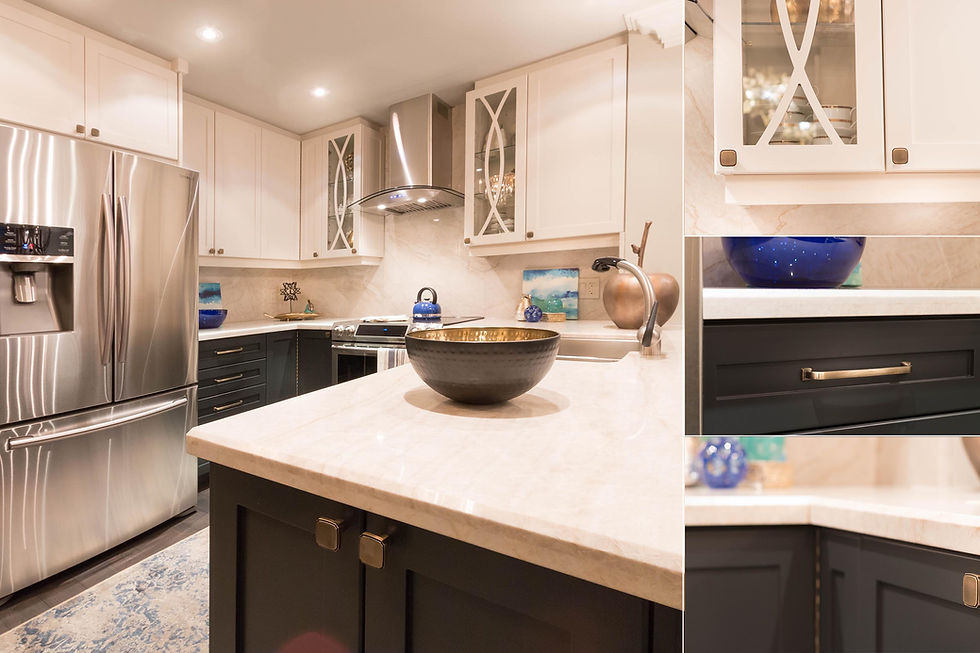
Why it matters: cabinet pulls, faucets, door handles, and light switch plates are some of the smallest things in a room, but they're also some of the most touched and most noticed, especially in kitchens and bathrooms. Builder-grade hardware (the plain, shiny stuff that comes standard in most homes) is one of the fastest tells that a room hasn't been updated.
The fix: swap dated or mismatched hardware for a consistent finish throughout the room, whether that's matte black, brushed brass, or brushed nickel. You don't need to touch cabinetry or plumbing to do this. It's one of the highest-impact, lowest-cost changes you can make, often under a few hundred dollars for an entire kitchen.
Get your lighting color consistent
Why it matters: "color temperature" is just a way of describing whether a light bulb looks warm and yellowish or cool and bluish-white. A room with mismatched bulbs, some warm, some cool, scattered across different lamps and fixtures, reads as cheap and unsettled even if every individual fixture is nice.
The fix: stick to one color temperature throughout a room, ideally in the warm range (around 2700-3000K, which most bulb packaging lists clearly) for living spaces and bedrooms. Replace any mismatched bulbs so every light source in the room glows the same way. It costs the price of a few light bulbs and instantly makes a space feel cohesive, meaning everything in it feels like it belongs together.
Invest in one anchor piece instead of many small ones
Why it matters: it's tempting to fill a room with a lot of smaller, less expensive pieces. But a room full of budget furniture, even nice budget furniture, tends to look busy and, frankly, budget. One well-made "anchor" piece, a sofa, a dining table, a bed frame, gives the eye somewhere to land and makes everything else around it look more intentional by comparison.
The fix: pick the piece your room is built around, and put your budget there first. Fill in around it with simpler, less expensive pieces. You don't need everything to be expensive, you need one thing to be good.
Iron or steam your drapery, and get the length right
Why it matters: I check curtain length in almost every client home I walk into, after 18 years of doing this, and it's one of the most common gaps between "fine" and "finished." Wrinkled panels or curtains that stop a few inches above the floor read as an afterthought, no matter how nice the fabric is.
The fix: steam or iron your curtain panels before hanging them, and choose a length that just grazes the floor (or intentionally puddles slightly, if that's the look you want). Crisp, floor-length drapery is one of the simplest ways to make a room look pulled together and considered.
Edit what's sitting on your surfaces
Why it matters: expensive-looking rooms almost always have less stuff visible on countertops, shelves, and side tables than you'd expect, not because the people who live there own less, but because they've chosen what stays out and put the rest away. A cluttered surface pulls attention away from the room itself and toward the mess of small objects competing for your eye.
The fix: clear every surface completely, then add back only a few chosen items, a stack of books, one plant, one tray for the everyday stuff you actually need out. Everything else goes in a drawer or a cabinet. This costs nothing and takes an afternoon, and it's one of the fastest ways to make a room feel calmer and more expensive.
These five changes are simple on purpose. None of them require a contractor, and none of them require you to touch a wall. If you want more of these no-renovation upgrades, I put together a free guide called 10 Things Your Decorator Knows That You Don't that covers the rest, and it's genuinely useful whether or not you ever hire a designer.
A room doesn't need a bigger budget to look expensive. It needs a few deliberate choices, made consistently, instead of a lot of small, mismatched ones.
Grab the free guide: 10 Things Your Decorator Knows That You Don't
Not sure where to start with your own space? Take the 2-minute style quiz to find your design direction.
Ready to go deeper? The Interior Designer's Rulebook has 250+ tips like these.

Thanks for reading!
Lenore 🤍


When looking into home updates, finding contractors with actual hands-on experience takes time. From what I have seen, companies operating for around fifteen years usually handle full scope projects like structural changes, plumbing, electrical work, and interior finishing fairly steadily. Having licensed workers and clear estimates helps avoid unexpected costs during major work. You can check https://house-renovations.ca/home-renovation-mississauga to see how typical service lists look for local contractors handling whole home or single room projects. Clear scheduling and a basic workmanship warranty are standard points to confirm before starting any serious renovation work.